Ravinder Kumar
Frontend and Web3 engineer in Mumbai, building React apps that hold up in production.
View my workAbout
I’ve spent the last three years mostly in the unglamorous parts of frontend: state that goes out of sync, wallets that fail silently, RPC calls that hit rate limits at 2am. That’s become my area. Most of my projects have been React and TypeScript at scale, on Web3 platforms, DeFi workflows, and a mobile app that had to render images 47,000px tall without crashing. The problems I like best only show up in production, like RPC overload under load, broken wallet states on mobile, and data that looks correct but isn’t. I care how the whole system holds up after the feature ships.
- Based in
- Mumbai, India
- Working since
- 2022
- Now
- Senior software developer at Rejolut
- Focus
- Frontend and Web3

Interested in
- Performance optimization
- Web3 application architecture
- Complex UI and state systems
- Cross-platform engineering
Worked at
- Rejolut2024 to now
- KJSS COSMOS2023 to 2024
- TCS2022 to 2023
Selected work
6 case studies from production.
Solana yield app
Stablecoin minting, staking and yield on Solana
Since November 2025 I have been building the web app and admin dashboard of a Solana DeFi platform where users mint stablecoin-backed assets, stake them and earn yield.
Client confidential. I can share the work, not the name.
Problem
The Earn page made dozens of RPC calls per visit, and rate-limit errors from the RPC provider set off retry storms. When a transaction failed or a wallet sat on the wrong network, users got a raw error with no next step.
What I did
- Moved the app from Create React App to Vite and its RPC reads to React Query with retry and rate-limit handling. Batched and cached on-chain reads with getMultipleAccounts, and wrote Playwright scripts that count the RPC calls each page makes.
- Built the token swap with quotes and slippage, on-chain vesting and rewards, and the liquid staking and BTC strategy flows.
- Replaced the wallet layer with Reown AppKit, covering Solana wallets and EVM wallets through Wagmi.
- Built an error system: a classifier, a policy table, a wrong-network check by genesis hash, and a modal for failed transactions.
- Built the admin dashboard, including compliance whitelist and blacklist pages and multi-token management, and wrote an Anchor migration in Rust for 8 mainnet whitelist entries stuck on an old account layout.
Impact
- RPC calls on the Earn page fell from 11 to 4 with no wallet connected, and from 43 to 9 with one connected.
- Rate-limit errors no longer trigger retry storms.
- A failed transaction or wrong network now shows a specific message instead of a raw error.
Built with React, TypeScript, Vite, Redux Toolkit, TanStack Query, Solana web3.js, Anchor, Rust, Reown AppKit, Wagmi, Vitest.
Web3 Admin Platform
RPC optimization and architecture refactor
I refactored a production Web3 platform so it stopped failing on RPC rate limits and its transactions went through reliably on desktop and mobile.
Problem
The app made direct RPC calls for its on-chain reads and writes. As usage grew it kept hitting RPC rate limits, which meant failed data loads, UI state that didn’t match, wallet adapter errors nobody could see, and mobile wallets that worked only some of the time.
What I did
- Moved the whole data layer to React Query for caching, deduplication and background refetching.
- Put the RPC calls behind shared service layers.
- Removed redundant calls across components and tightened query invalidation.
- Switched to signTransaction + sendRawTransaction so raw transaction errors came through intact.
- Made mobile wallets work more reliably and their failures easier to debug.
Impact
- Cut the RPC rate-limit failures that were blocking user transactions at peak load.
- Trading and portfolio views now show consistent data.
- Failed transactions report the contract-level error, so they are easier to debug.
- Left the platform with an architecture that could actually grow.
Built with React, TypeScript, React Query, Web3, wallet adapters, RPC optimization.
Crypto wealth app
Crypto trading, lending and wealth management
I worked on the trading, lending and investing flows of a high-traffic crypto finance platform, mostly on real-time updates and making transaction state clear.
Client confidential. I can share the work, not the name.
Problem
The platform needed portfolio values that updated in real time, PnL that matched everywhere, liquidation risk that users could see, and fiat on-ramp and off-ramp, all while blockchain settlement happened asynchronously.
What I did
- Built the trading, lending and investing flows, with clear feedback on order placement and position health.
- Built loans with an LTV slider, deposits and withdrawals through BitGo, and Coinbase Pay deposits.
- Integrated fiat on-ramp and off-ramp providers and wallet connections.
- Agreed API contracts for quotes, balances, positions and PnL so the real-time views matched, and managed state with event listeners and background polling.
- Added optimistic UI, skeleton loaders and transaction timelines so users could follow each state change.
Impact
- Slippage, collateral ratios and liquidation thresholds are clearer to users.
- Users see each transaction state and confirmation as it happens.
- Portfolio analytics stay consistent through live updates and settlement.
Built with React, TypeScript, Vite, Tailwind CSS, styled-components, Wagmi, viem, Auth0, Cypress, Vitest.
RVV Portal
Decentralized token claiming and staking DApp
I built a Web3 app for claiming, staking and swapping tokens, with several wallets supported and on-chain state that stays accurate.
Problem
Under network congestion, users got unreliable feedback on their transactions. Showing the true on-chain state took receipt listeners, reorg handling and RPC failover.
What I did
- Added multi-wallet support with RainbowKit and Wagmi.
- Wrote the on-chain reads and writes with Ethers.js.
- Designed typed ABI layers and reusable hooks for balances, allowances and approvals.
- Built guarded flows for chain switching, approval gating and insufficient funds.
- Used event-based updates and receipt listeners for confirmations and reorg handling.
Impact
- Transactions became more reliable during heavy network congestion.
- Made connecting with several wallets smooth for users.
- Guarded flows cut down user errors.
- Set up a modular frontend architecture built to scale.
Built with React, TypeScript, Ethers.js, Wagmi, RainbowKit, EVM, Web3.
RejoAI
Frontend architecture built to scale
I built the frontend architecture from scratch: the component system, API layer, Redux state, error boundaries and analytics.
Problem
Starting from a blank slate, the product needed structured API contracts, error handling that held up, and consistent UX across authenticated and action-driven workflows.
What I did
- Built componentized layouts with accessible, responsive patterns.
- Integrated REST APIs with standard request and response contracts.
- Added retries, exponential backoff and structured error handling.
- Set up state management with Redux and the Context API.
- Integrated analytics and telemetry to see which features got used and guide UX changes.
Impact
- Shipped a consistent, API-driven frontend built from the ground up.
- Error boundaries stopped silent failures from reaching users.
- Caching cut redundant network calls across feature flows.
- A clear data architecture made feature work predictable.
Built with React, TypeScript, Redux, Context API, IndexedDB, REST APIs.
Manga Reader
React Native app that renders very large images
I built a long-strip manga reader for very tall images, with smooth zoom, scroll tracking and saved reading progress.
Problem
Chapters had images up to 47,000px tall, which caused memory pressure, laggy rendering and unstable zoom. The reader also had to track progress from the scroll position and keep it between sessions.
What I did
- Added zoom with react-native-image-pan-zoom.
- Tracked reading progress from the scroll position and persisted it with Redux.
- Structured the app so images can later load from an API.
- Changed the rendering approach to use less memory.
- Built a smooth long-strip reading experience similar to Tachiyomi.
Impact
- Zooming and panning stay smooth on very large images.
- Image-heavy chapters use less memory.
- Readers pick up where they left off, with zoom and scroll position kept.
- Long reading sessions stay fast on a phone.
Built with React Native, TypeScript, Redux, Expo, image optimization.
Client websites
 (opens in a new tab)
Gausiya ExportsExport businessA site for an export business, laid out around its product range.Next.js, React, Next API, HTML/CSS  (opens in a new tab)
KodethatWeb and AI studioThe site for a Navi Mumbai studio that builds AI chatbots, WhatsApp automation, websites, apps and CRMs, with a Supabase admin for blogs, enquiries and analytics.Next.js, React, Supabase, Google Analytics API  (opens in a new tab)
APS for HumanityNGOA donation site for an NGO supporting families in Ghazipur, with Razorpay payments and a Laravel admin for donations, pledges and help requests.Next.js, React, Razorpay, Laravel, Filament 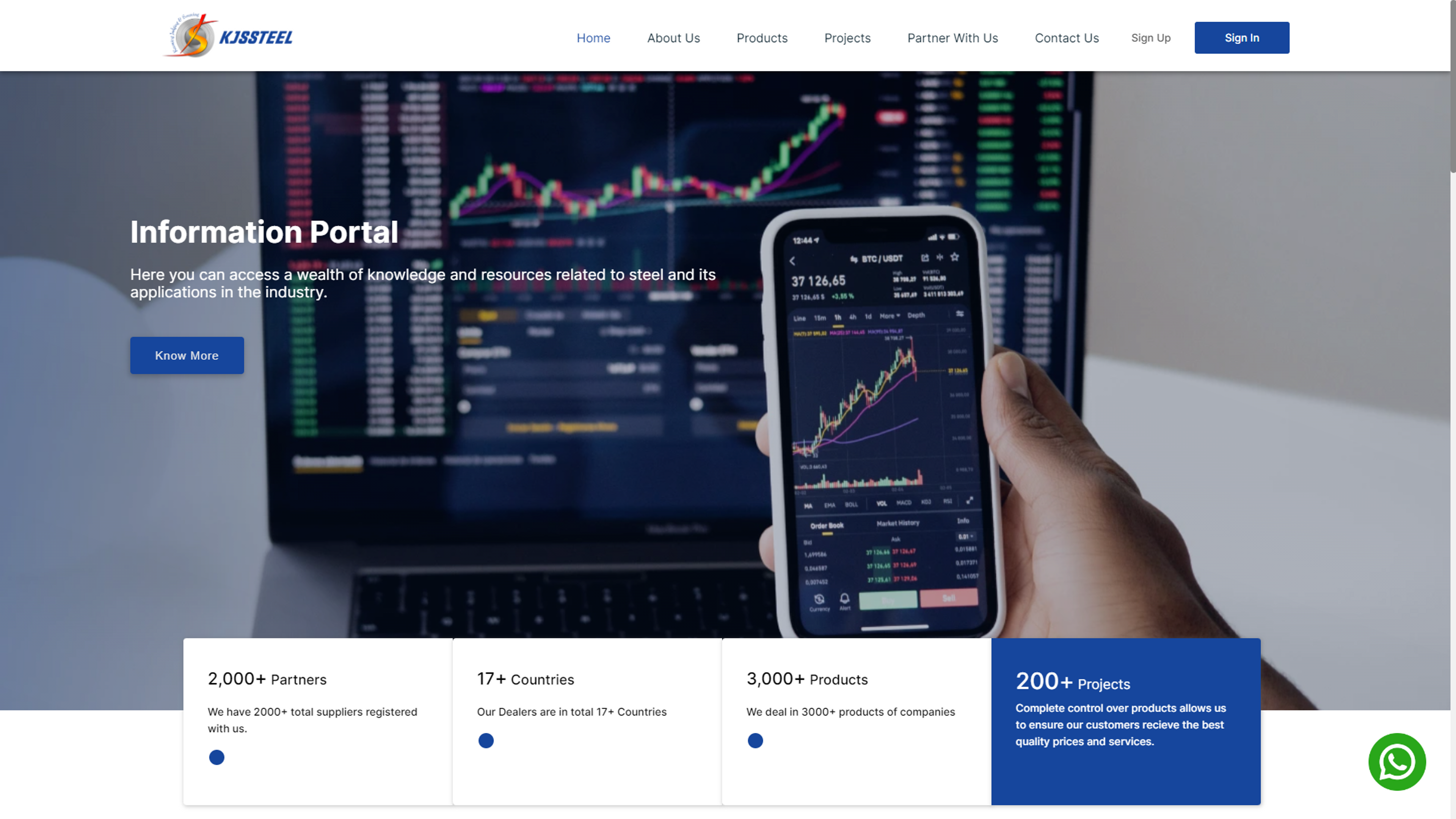 (opens in a new tab)
KJS SteelSteel companyA company site I helped build, showing its products and services, with a custom CMS.React, Java, Spring Boot, SQL, HTML/CSS
I also worked on Proca, a procurement portal for steel plants at KJSS COSMOS, and built the Sidmark (opens in a new tab) site for an HPL and LPL surfaces company, with a custom CMS.
Experience
Rejolut, a GenAI and Web3 company
Senior software developerMumbai, MHDec 2024 to present
Promoted from full stack developer (Dec 2024 to Jun 2025).
- Since March 2025, built frontends for a confidential crypto client: a wealth management app, and a Solana DeFi yield app with its admin dashboard.
- Designed and owned full-stack Web3 apps for token claiming, staking and DeFi workflows on EVM-compatible chains.
- Integrated smart contracts with Ethers.js, Wagmi and RainbowKit, handling the transaction lifecycle, confirmations, reorgs and failures with clear feedback to the user.
- Built secure backend APIs with NestJS, PostgreSQL and Prisma, with authentication, RBAC, request validation, structured logging and error handling.
- Built event-driven UI updates, optimistic rendering and background polling to cope with blockchain latency and uneven RPC performance.
- Contributed to architecture, performance and system design decisions in cross-functional agile teams.
Built with React, Next.js, TypeScript, NestJS, PostgreSQL, Prisma, Ethers.js, Wagmi, RainbowKit, Solana, Anchor, Web3.
KJSS COSMOS Pvt. Ltd. (KJSSC)
Frontend leadMumbai, MHJun 2023 to Aug 2024
- Led a team of 4 developers building frontend systems with React.js, Next.js, TypeScript and Tailwind CSS.
- Worked with backend teams to define API contracts, standardize error handling, and optimize pagination and caching, which cut integration issues by 20%.
- Improved performance with code splitting, memoization and bundle optimization, making pages load 15% faster.
- Set up reusable component libraries, documentation standards and structured code reviews to help the team ship faster and keep the code maintainable.
Built with React, Next.js, TypeScript, Tailwind CSS.
Tata Consultancy Services (TCS)
Software development associateVaranasi, UPFeb 2022 to Mar 2023
- Learned enterprise Java development and the SDLC at scale.
- Worked within structured engineering processes: code reviews, documentation standards and release cycles.
- Earned internal certifications in Java, data privacy and professional communication.
Built with Java, enterprise SDLC.
Skills and tools
Frontend architecture
React, Next.js, TypeScript, Vite, React Native, Redux, React Query, Tailwind CSS, component systems, state management, performance optimization.
AI and agents
Claude Code, agentic coding with subagents, writing Claude Code skills, system prompt design, LLM inference with Hugging Face (Mistral 7B), NLP with transformers and VADER, LSTM forecasting with TensorFlow, llms.txt and AI search visibility.
Web3 and blockchain
Solana, Anchor, Rust, Ethers.js, Wagmi, viem, RainbowKit, Reown AppKit, EVM, tBTC, wallet integrations, transaction lifecycle handling, RPC optimization, event listeners, chain reorg handling, approval gating, DeFi workflows.
Backend and APIs
NestJS, Laravel, Filament, PostgreSQL, Prisma, Supabase, REST APIs, Razorpay payments, authentication, RBAC, request validation, structured logging, retry policies, webhooks.
Performance and systems
code splitting, memoization, caching strategies, RPC call batching, optimistic UI, background polling, rate limiting, large image rendering, mobile performance engineering.
Tooling and workflow
Git, Docker, GitHub Actions, SonarQube, Sentry, Playwright, Vitest, Jest, Cypress, code reviews, technical documentation, structured debugging, telemetry integration, Agile methodology.
Contact
- [email protected]
- Based in
- Mumbai, India